Synesthesia is a word I’d never heard of before. It is defined as the production of a sense impression relating to one sense or part of the body by stimulating another sense or part of the body. So, if you’re listening to music and you see the colors of the rainbow, that’s synesthesia. You also might be on drugs, but it’s still called synesthesia.
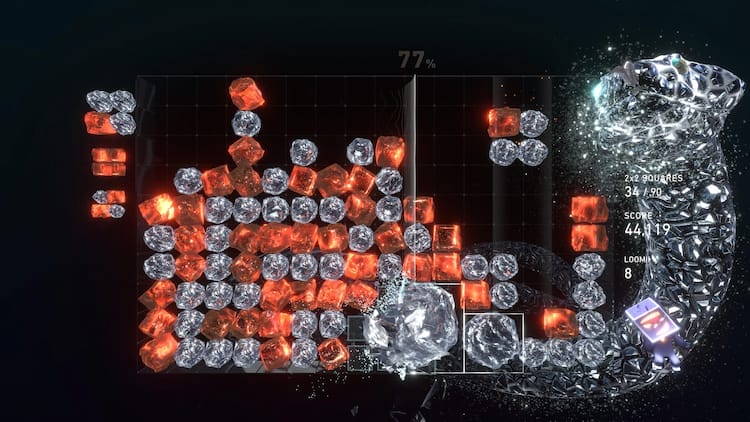
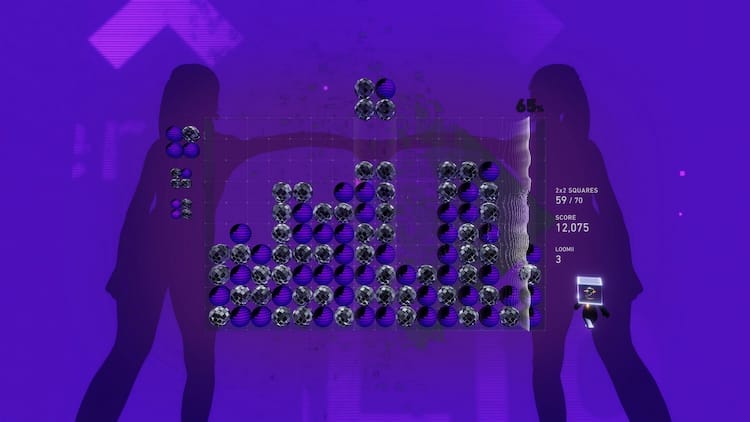
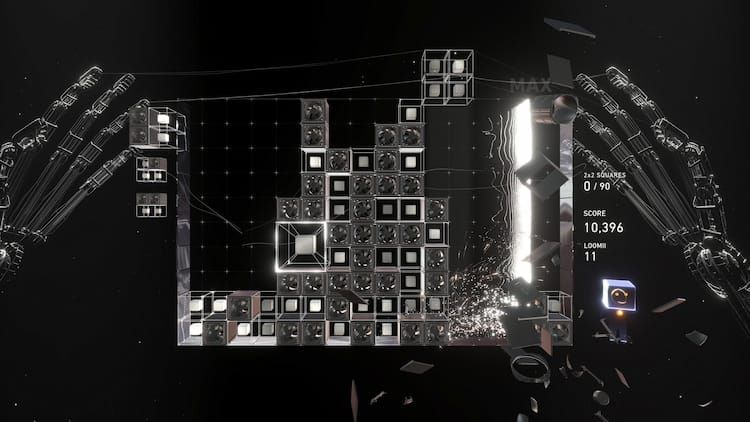
That is what Lumines: Arise developer, Enhance, is obsessed with, and you can tell. The puzzle game that involves making squares of two different colors over and over again is a feast for the senses, featuring a banging soundtrack, varied and dynamic backgrounds, and blocks that feel alive.
But was all of that too much to handle, or did I taste EDM, smell blue, and see the inner workings of life itself?
Gameplay
Lumines is Lumines. The idea is that you need to make squares. Simple, right? Wrong. Because it’s so much more than that.
You need to make squares, the bigger the better, to clear the blocks from your screen so that you have more room to make more squares. Think of Tetris, except instead of making lines, you make squares. The other difference is that the squares are only wiped at specific intervals, and the tempo of the music determines that frequency. You might be thinking, “I can make a square there!” but that might be a race against time before something wipes and the blocks ruin your move. It’s a balance you need to strike between rushing to construct lots of squares and the potential for ruining your board by being too late.
Aside from making squares, there are a couple of modifiers that can help your run. Chain blocks can wipe blocks of the same color that are touching each other in a… chain. You get it. You can perform massive combos if you use those chain blocks correctly. The other modifier is a Burst. These essentially freeze time and allow you to make the biggest square possible of the same color. Your puzzle pieces don’t drop on their own, and you just need to make the biggest square possible. It’s your chance to clear a LOT of blocks at the same time, so you better try to be as efficient as possible. I’m not gonna lie, Bursts got me out of trouble a helluva lot.
The puzzle mechanics are really fun, but I’m not very good at it. I beat the Journey on Normal (which I’m pretty proud of), but I can’t say that my brain works in the way it’s supposed to for this game. I often made silly unforced errors because I couldn’t work out how the blocks would slide, fall or drop. I think it’s one of those games that you can either do or you’re gonna struggle.
Modes
Every different mode is a variation on a theme, and why shouldn’t it be? As I’ve already said, the core game is simple: make squares using different configurations of a 2x2 square. You wouldn’t expect Pong to give you a 3rd person shooter mode, so why expect it in Lumines?
The Journey is the focus point on the main menu, which is different levels strung together, daring you to survive. Each stage in Journey consists of four levels, which usually share a visual theme, like technology or nature. If you fail halfway through, it’s your choice whether to continue from the level you’re on or to go back to the beginning to rack up a higher score. I was thankful for this because I often found myself unable to be consistent enough to produce 20 minutes of good concentration to be able to complete the stage in one go. Once you’re done with Journey, you unlock Survival, which just lets you try to go for as long as you can.
Multiplayer is a one-on-one fight with someone online. The idea is that you try to get the best combos and score possible, and the better you do, the more garbage blocks you inflict on your opponent to ruin their day. When the other player can’t play any more blocks, you win, and it’s a best-of-three match. Multiplayer isn’t what I’m here for, and my skill level means that I have played five matches and have not come close to beating anyone yet. Maybe it would be something I would have liked locally with friends, but definitely not with the online sickos.
The other mode of note is the challenges and training. I went through a bunch of these after being completely useless on Stage 3 or 4, and it instantly helped me understand this game’s mechanics much better. As you progress through the challenges, you have to make more and more squares with specific block configurations within a time window, and once you get what it’s asking for, it’s like you’re seeing through the matrix. This mode is very helpful.
Style
So, enough of this chat of puzzles. We need to talk about the real meat and potatoes of Lumines: Arise: the style.
I wrote in the preamble about “synesthesia”, and that is because of the visuals and soundtrack of this game. This soundtrack is banging, and it works extremely well with the different block pictorials. Those designs were really cool, and they can change over time. One stage has broccoli and red peppers (green and red), and, as the song plays, they change art style. There is one stage where the black blocks have a little fluorescent man, like from pedestrian crossings. When a clockwork-y song plays, the blocks look like clock faces and cogs. It’s really cool. Also, I’ve had this one song in my head for like a week and I can’t get it out.
However, on some boards, I found it difficult to keep track of the two different colors of blocks, meaning it became a lot harder to make the required squares. That, accompanied by the dynamic moving backgrounds, sometimes made it almost impossible to find any sort of rhythm with the core mechanic of the game. I found myself trying to ignore the noise around the screen and instead concentrated only on making squares.
Therefore, I was actively trying to NOT be synesthesiased. I know that’s not a word, and I don’t care. Listen, out of the 35 different stages and songs in this game, I felt this way about maybe five of them, but it’s still a decent chunk where I almost muted the game to lock in. That’s not the concept of this game’s design, so, in this respect, I didn’t think it worked one hundred percent of the time.
Summary
Lumines: Arise is a simple game, but what it does, it does exceedingly well. For a game about making squares and surviving as long as you can, it makes that loop so compelling that it’s hard to put it down. Like some roguelikes, it’s got that “one more go” itch that makes you stay up until 2 am. I need to stop ruining my sleep patterns.
It has insane visuals and an amazing soundtrack that Enhance-s (get it?) the experience. However, for some people’s brains, that overstimulation could be a little too much. On a handful of stages, I was no longer one with the game, but I was fighting against it, and that’s a damn shame.
Luckily, there’s a playlist mode, so I don’t ever have to see those levels again.
Lumines: Arise is available now for PS5, PSVR2 and Steam right now for around $39.99.
Hey fellow nerds! Before you dive back into that gaming session or start your next binge-watch, here’s the deal with Couch Soup: we’re a completely independent pop culture site run by genuine fans who get just as hyped as you do about the latest games, comics, movies, and TV shows. No corporate overlords, no AI-generated content, just real people who know their Metroid from their Mass Effect.
Unlike the big corporate sites, we don’t chase clicks or stir up drama. Sure, we might have some hot takes (looking at you, controversial season finale), but they come from a place of genuine passion and respect for the creators and fandoms we cover.
Want to support what we do and join what we think is the coolest community of pop culture enthusiasts on the internet? Check out our supporter tiers – each packed with perks that’ll level up your fandom experience. Every contribution helps keep us independent and lets us keep nerding out with you!
Thanks for being part of our quest – now, back to our regularly scheduled geekery!
A northerner from England, Iain is passionate about all things film, TV, and video games (he has an obsession with popping them trophies in PlayStation games). When not consuming pop culture, Iain can be found drawing on MS Paint, learning Mandarin, watching football (soccer), or at pub quizzes. Mostly the pub thing, although he actually has not drunk a drop of alcohol since a messy Christmas Eve over a decade ago...
Hmmmmm. I'm not sure about this, guys. Unless this is an alternate universe type of thing, I don't like Stranger Things having more intricate and special monsters in the off-screen times. Also, voice cast feels weird. I'm sure good. But weird.
The one man fighting force who has taken down small town cops to entire armies, and most recently, the cartel is back as an origin story titled "John Rambo". One reason to get excited is that this is being directed by the visceral director of Sisu, which means this will and should be a rated […]
Lassos back, alright! Fans rejoice! Our screens will be blessed again by our beloved Ted Lasso cast once more as they are coming back for a 4th season! Can't wait! Gosh dang it, I BELIEVE it's what we need now, more than ever!
Watch out, lovers of trashy American reality TV! There's a new show moving into the neighborhood, and it looks like a doozy... And I don't hate it. Wow! This looks like it's going to be extremely entertaining. What do you think?
Jack Black and Paul Rudd have teamed up in a reboot of a series where the plot is that they’re rebooting the original film (it makes sense), and that film is Anaconda. Join Tom as he gives his thoughts on this unique way to reboot a franchise.
After following the Abbott Family in Quiet Place Part 1 and 2 it is time to go back to day one when it all started. The big question is - as always - did they capture the essence of what made the originals so successful? Let’s dive in.





















Does this game come with a warning not to play while on drugs? I feel like I want a Twitch channel just dedicated 24/7 to playing this game.
no warnings unfortunately. It's trippy tho