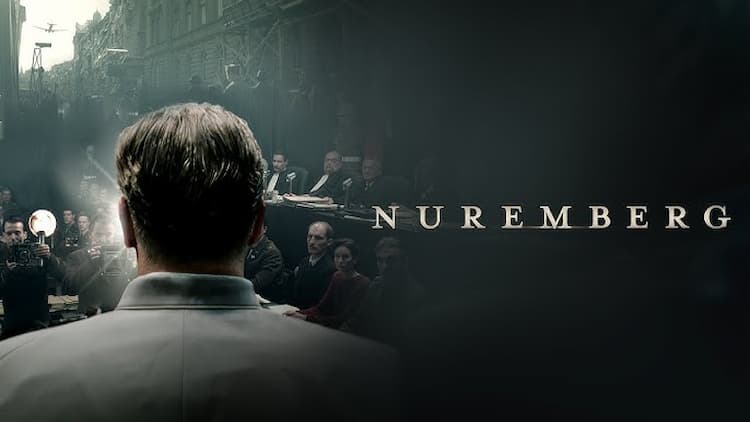
WWII films have been a staple for decades at this point, and they have spanned nearly every part of the war you could think of. There are films like Midway, which focus on the Battle of Midway, or Fury, the story of a tank unit moving through Europe. Hell, you could even consider Godzilla Minus One as a WWII film if you try hard enough. My point is, there are a lot of films set in this time period, but not many (at least the mainstream ones) tackle the immediate aftermath of the war. This is where Nuremberg, directed by James Vanderbilt, comes in, shining a spotlight on the Nuremberg trials. These were the trials of the remaining Nazi command, which took place soon after the end of the war. Is Vanderbilt able to create an engaging film out of a court trial, or will Nuremberg disappear into an ocean of WWII films?
The Trial Of The Nazis
Evil bastards. (Sony Pictures Classics)
It’s May 1945, and the Nazi’s are on the way out. Hitler is dead, and the regime is preparing to surrender to the Allies any day now. Most of the Nazi high command have been rounded up or have surrendered in an attempt to save their own skin. This includes Reichsmarshall Hermann Goring, Hitler’s second-in-command, who surrendered to the Allies alongside his family. Once the world catches wind of Goring’s arrest, Robert Jackson, an Associate Justice in America, comes up with a crazy idea: putting the Nazi’s on trial for their crimes instead of just executing them.
While there were some hoops to jump through (including blackmailing the Pope), the trial is given the green light and the Nazi prisoners are moved to the city of Nuremberg, the site of the proposed trial. America also brings in U.S. Army psychiatrist Major Douglas Kelly to evaluate and monitor the mental health of the prisoners, but most importantly, that of Goring. With the world watching and Goring seemingly having tricks up his sleeve, how will the Nuremberg Trials be remembered for years to come?
I wouldn’t say that I had fun with the story in Nuremberg, but I was invested the entire time. The film does a good job of keeping you engaged with a story where you already know the outcome, while having you guessing throughout who really had the upper hand leading up to the trial. And while this is a very dialogue-heavy film, it doesn’t reach a point where you get bored or start craving action. That’s not to say it’s without fault, as some scenes do stick around for a tad longer than they should, with some feeling a bit pretentious, but it doesn’t harm the film that much. It also tends to tell you the story rather than show it. By which I mean the film sometimes overexplains what’s happening in a scene instead of letting you just figure it out yourself. It didn’t ruin the experience, but it did get a tad annoying.
A Charismatic Man
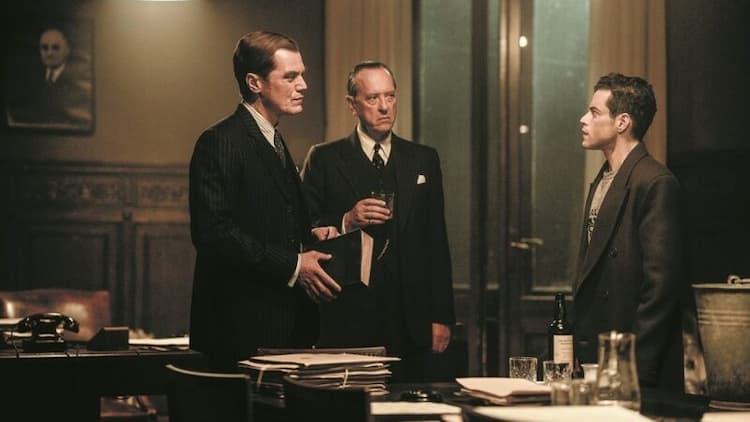
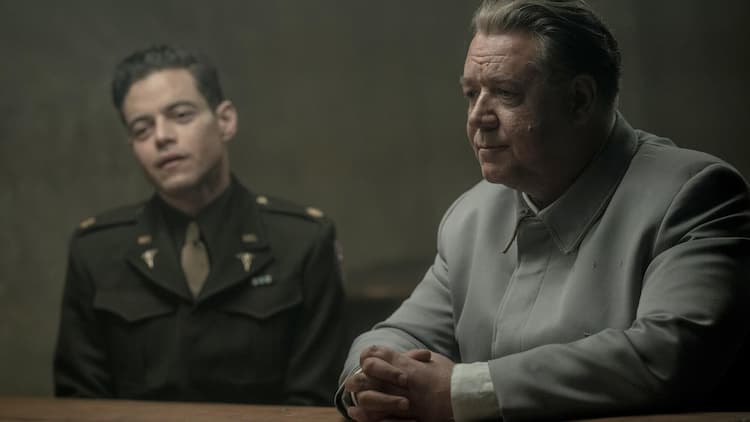
Strategy time. (Sony Pictures Classics)
A big reason that I wanted to check out Nuremberg was the stacked cast, and they all put in phenomenal performances. Rami Malek as Douglas Kelly and Russell Crowe as Hermann Goring are the standouts by far, with both of them nailing their roles. Malek’s curious, optimistic take on Kelly at the start of the film makes his eventual fall into cynicism by the end feel that much more impactful, especially with his relationship with Goring and the other Nazis. It’s brilliant, and Malek proves why he’s held in such high regard.
Similarly, Russell Crowe brings an air of intimidation and control with his performance, always making the audience feel like he has multiple plans to get out of his situation. This is also the first time in a while that Crowe’s one European accent he can do is actually enjoyable instead of hilarious (man can legit only do one type of accent). His performance really drew you into the character, who I just want to clarify was a despicable monster, but you can see why people would follow him. How accurate Crowe’s portrayal was, I don’t know, but he did brilliantly regardless.
The rest of the cast also did fantastic jobs, really adding to the film's overall vibe. Michael Shannon as Robert H. Jackson, Richard E. Grant as Sir David Maxwell Fyfe, and John Slattery as Burton C. Andrus were some of my favourites, as each commanded the screen whenever they popped up. I’m so used to seeing Michael Shannon as a villain that it caught me off guard when he was the good guy (relatively speaking). And Richard E. Grant’s ability to be both intimidating and unintentionally funny will never get old, with the best example here being drinking booze from a teacup (gotta look fancy even when getting shitfaced). Overall, a great cast that all put in award-worthy performances.
Horrors Of War
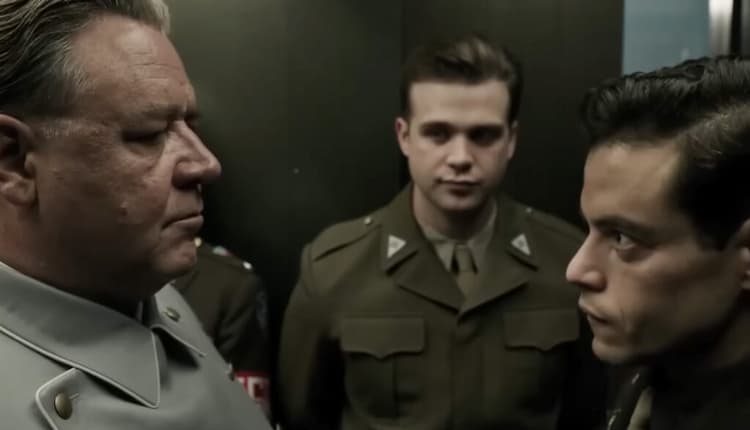
Face-to-face with evil. (Sony Pictures Classics)
Nuremberg, for the most part, is a well-shot film with numerous scenes that look outstanding. Whether it be the small moments between Kelly and Goring in a cell with Kelly trying to pry information away from Goring, or the wide shots of the Nuremberg trial that make everything feel larger than life, everything looks great. That is, with the exception of quite a few continuity errors that I noticed throughout the film. Normally, this stuff doesn’t bug me too much, as I’ll notice maybe one or two, but I caught several instances here, and it just increasingly annoyed me. Things like characters facing one direction in one shot and then being nowhere near that position in the next. Or objects on a table not being consistent between cuts, I started fixating on all these small details. Does this matter to the casual moviegoer? Of course not, this is just me being pedantic about details, but it still bugged me.
What I do think will matter to casual moviegoers is the archival footage of the concentration camps shown in the film. I was expecting some type of recreation of the events, or maybe just the audio, but nah, they show you the real deal. It does wonders for making you feel disgusted by Goring and the Nazis, which helps keep you invested in the film, but it may also prove too much for some. Just a fair warning for anyone who can’t handle seeing this type of stuff, as none of it is censored.
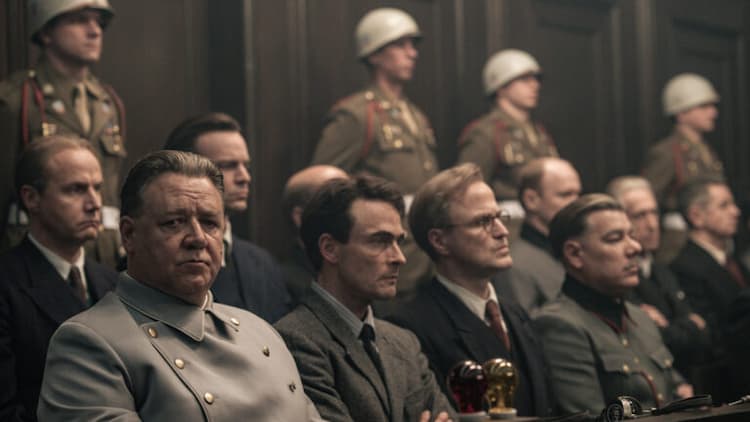
Who was really in charge? (Sony Pictures Classics)
I wouldn’t say I had fun watching Nuremberg, but I’m glad I saw it. It’s an important story to tell, especially today with everything going on. The performances are excellent across the board, and for the most part, the film looks fantastic. Some issues with the story's presentation and scene continuity prevent this from being one of my favourites of 2025, but it may be one of the more important WWII films released in recent years.
Have you seen Nuremberg? What did you think? Did you already know the history? Let us know in the comments where we can all talk about Russell Crowe’s one European accent.
Hey fellow nerds! Before you dive back into that gaming session or start your next binge-watch, here’s the deal with Couch Soup: we’re a completely independent pop culture site run by genuine fans who get just as hyped as you do about the latest games, comics, movies, and TV shows. No corporate overlords, no AI-generated content, just real people who know their Metroid from their Mass Effect.
Unlike the big corporate sites, we don’t chase clicks or stir up drama. Sure, we might have some hot takes (looking at you, controversial season finale), but they come from a place of genuine passion and respect for the creators and fandoms we cover.
Want to support what we do and join what we think is the coolest community of pop culture enthusiasts on the internet? Check out our supporter tiers – each packed with perks that’ll level up your fandom experience. Every contribution helps keep us independent and lets us keep nerding out with you!
Thanks for being part of our quest – now, back to our regularly scheduled geekery!
Self-proclaimed anime trash from Melbourne, Australia, Thomas has always been obsessed with everything pop culture. From games such as Pokémon and Jak and Daxter to the MCU and everything in between. When he isn’t hyper-fixated on some new shiny release or feeding his manga buying disease, Tom is always trying to create new things that can bring a smile to anyone's face.
What a fun tease for the upcoming year of television at Netflix. From Bridgerton to One Piece to Peaky Blinders and so much more, it's safe to say there is plenty I am excited to binge... er... watch this year in one or more sittings. 😉 What are you looking forward to?
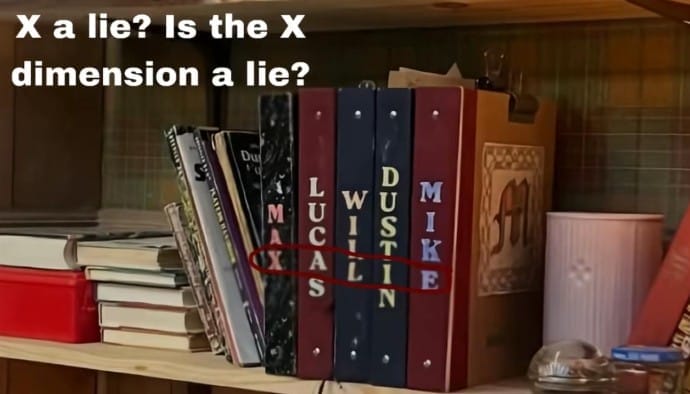
There's a rumor (or wild unhinged speculation) that the finale of Stranger Things wasn't ACTUALLY the finale, and it's a fake ending where everyone is just stuck inside Vecna's mind still. Do you believe that X is a lie? Or that Karen Wheeler's scars are actually gone? Some people think S5, Episode 9 is on […]
Funnily enough, the man who has invested billions into AI, Satya Nadella, wants us, the consumer, to stop calling his toys slop. Just backfired, my friend! NOBODY LIKES COPILOT!
I know a lot of people love him for his role in The Wire and his SHIIIIIIIIIIIIIIIIIIIIIIIiiiiii meme, but here's one of my favorite scenes from Cocaine Bear. RIP Mr Whitlock Jr.
Do the Upside Down’s monsters live up to the tabletop hype? I’m dusting off the Monster Manual to pit the show’s villains against their original lore. Are they a Total Party Kill or just a low-level encounter?
Bursting with heart and flavors of New Caledonia, Tchia will possess your heart and never let it go. Let’s have a look at one of the most unique and beautiful indie games we’ve seen in a very long time.
The latest anime film, Chainsaw Man – The Movie: Reze Arc, has hit cinemas, but is it worth your time? Join Tom as he answers that question and more in his review.















Always love WW2 films that go hard. This seems to check that box. I'm in.
Yeah, I'm in. I'd like to see this.